M.S. — Georgia Tech
My master's project was a normalizing flow used for density estimation of Directors & Organizations (D&O) insurance cases

Georgia Tech M.S. & Virginia Tech CS grad · Testing Software Lead for VT Baja · Hobbyist developer
I'm a Computer Science graduate of Virginia Tech (Class of 2022). I chose CS because I enjoy solving difficult problems with code, and I believe engineering can make a positive impact on the world. My work spans autonomous systems, XR interaction, machine learning, and robotics — from self-driving car perception to Rocket League bots.
I use machine learning on satellite imagery to help map mass graves. With Khthon, a humanitarian organization using satellite and open-source intelligence to locate, analyze, and monitor mass graves and war crimes in conflict zones worldwide, I build the ML pipeline — collecting grave data from OpenStreetMap, training classifiers on satellite imagery datasets like fMoW, and running inference to flag potential grave sites at IDP camps in Sudan, Somalia, Syria, Haiti, and beyond.
My fantasy-baseball-stastics project treats fantasy baseball like a portfolio-management problem, with two branches exploring it from different angles.
Borrowed from finance, the Sharpe ratio measures return per unit of risk. I score every player's projected stats (R, HR, RBI, SB, OBP) as an expected return and use the spread of expert projections as volatility — so a steady 30-homer bat can justifiably outrank a risky 40-homer one.
Fantasy Pros Projections become draft-day-ready S–F tiers for hitters, starters, and relievers. Each category is converted to a z-score and summed into one rating, then players are bucketed into tiers with auction dollar values attached — so you always know who to target and when a position is about to dry up.
Top of the current hitter tiers from the tier_list branch.
ML pipeline for Project Khthon — using satellite imagery to map mass graves via OpenStreetMap data collection and classifier inference.
Risk-adjusted baseball stats using Sharpe ratios, plus a linear-program approach to building optimal rosters for auction-style fantasy drafts.
A QUBO protein lattice generator for folding proteins on a quantum annealer.
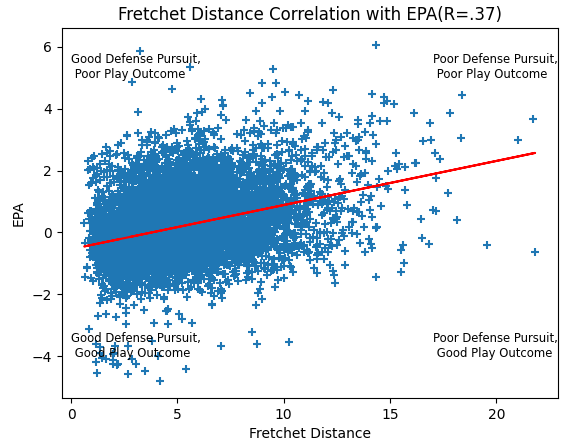
My second Big Data Bowl project — an aggressively playing chess AI built as a Kaggle notebook.
A Rocket League bot built with RLBot that competed against some of the world's best bots at the Lightfall tournament in October 2019. More at rlbot.org.
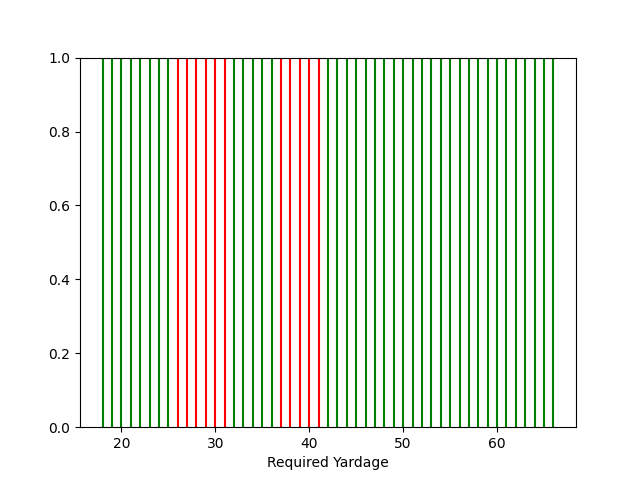
A k-nearest-neighbors field goal range model built on target zones for the Big Data Bowl, with a white-box decision tree interpreter.
A C# chess AI for Sebastian Lague's Chess Challenge tournament — finished ranked 103rd of 624 bots.
My master's project was a normalizing flow used for density estimation of Directors & Organizations (D&O) insurance cases
Graduated with a Computer Science degree while leading VT Baja's testing software and working on autonomous vehicle perception.
Built systems that sense and interpret a self-driving car's surroundings. On the Maps subsystem I used GPS and HD maps (PostgreSQL) via a ROS localizer node to look up the car's lane, lane offset, and speed limit. On the Computer Vision side I worked on neural network nodes for detecting signs, traffic lights, and obstacles using YOLOv3 and OpenVINO.
First, my team designed a QUBO program for the NP-complete subgraph isomorphism problem, constructing Q matrices via penalty functions so the minimum energy state mapped to a correct answer. We ran our QUBO program on a quantum annealer to find vulnerabilities in call graphs. Second, I worked on controls for a lighter-than-air soccer-playing aircraft: a PID controller for stability, an autonomous camera search pattern, and grabber logic, all in ROS and C++.
Led the backend team for an augmented-reality startup, handling loading, storage, and placement of AR objects. Tackled monocular depth estimation using SLAM, and deployed AWS S3 + CloudFront to store and distribute AR assets quickly.
Team member on an iOS app that evaluates the health of bee hives, giving hobbyist beekeepers an easy way to assess hive health.

Programmed the sensor suite for the Virginia Tech Baja 2020 car in C++ — reading data from the Inertial Measurement Unit (IMU), linear potentiometers, and other sensors, plus software that logs everything to CSV files.
Designed and implemented the routing algorithm that orders package deliveries for drivers around Blacksburg and Christiansburg, constantly iterating on new approaches to increase throughput.